
Best No KYC Casinos – List of no Verification Platforms in 2026
We reviewed 70+ no KYC casinos for UK players and rejected 43 before building this ranking. The biggest red flags were vague licence details, unclear withdrawal limits, bonus terms that changed after registration, weak responsible gambling tools and verification rules that did not match the “no KYC” promise.
Every casino left in our review process was checked against the same practical criteria: sign-up speed, ID request triggers, crypto and GBP payment options, cashout timing, AML limits, game provider quality, RTP visibility, mobile performance and support response time. This review shows the no KYC casinos that performed best in our testing, with clear notes on where reduced verification works – and where you may still be asked for documents.
Our Rated No KYC Casinos for UK Players
We logged deposits, cashouts, and the exact point where KYC kicks in on every operator on this page, then weighed those results against each licence and the operator’s track record in the UK. Withdrawal speed weighed heavily, along with how close a platform came to instant crypto payout in practice. Logged, not claimed. The ranking below reflects what each best no KYC crypto casino delivered, not what it promised.














Every brand above cleared the same hands-on process, with no paid placements. Spots are earned, full stop. How we rate sits further down, where you’ll see why these picks differ from other best No KYC Casino crypto lists online. Pick a brand from above, then keep reading to see why.
What Are No KYC Casinos and How Do You Benefit?
We define a No KYC Casino as a real money site where UK players in 2026 can sign up and cash out standard amounts without the document chain that traditional UKGC platforms require by default. Most of these sites run on crypto rails, and that single technical choice is what makes the speed and the privacy possible. The trade-off goes both ways. The table sets out where the gap actually lands.
| Traditional Casino | No KYC Casino |
| Sign-up: 5-15 min + docs | Sign-up: Under 60 sec |
| Withdrawal: 24-72 h verified | Withdrawal: 1-60 min |
| Documents: ID, address, funds | Documents: None on standard |
| Payment: Bank, card, e-wallet | Payment: Crypto plus options |
| Data: Full identity file | Data: Minimal / wallet-only |
The practical pull for UK players is the time saved at both ends, sign-up and cashout, with far less personal data sitting on casino servers along the way. We saw the same pattern on every brand we tested. Reduced data, not invisibility. Where each platform sits on that privacy scale comes apart in the next few sections.
What Documents Are Used for KYC Checks
Standard KYC at a UKGC-licensed casino runs on a fixed checklist with three goals: confirming who you are, where you live, and where your money comes from. We broke down each request. The pack below is what a player meets on the regulated track, lined up against the AML rules each casino is required to follow.
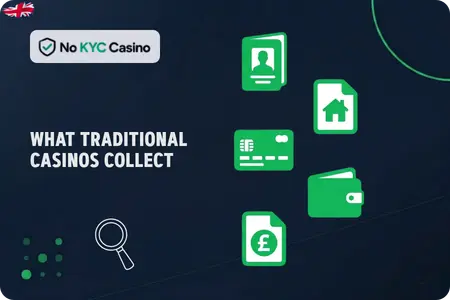
- Government-issued ID. A clear photo of your passport, driving licence, or national ID card with all four corners visible and 6 months left before expiry. Blurred shots, cropped edges, or glare on the data are common rejection reasons, with a separate selfie holding the document often requested alongside.
- Proof of address. A utility bill, council tax letter, or bank statement from the last 3 months, showing the same name and address as your casino profile. Mobile bills, shop receipts, and online banking screenshots are usually rejected. Council tax and utility bills (gas, electric, water) tend to clear first time.
- Debit card photo. The front of the card used for deposits, with the first six and middle four digits covered, leaving the last four digits, cardholder name, and expiry visible. The name must match the casino account, and a back photo is sometimes asked to confirm the CVV is hidden.
- Wallet ownership proof. For e-wallets like PayPal or Skrill, a screenshot of the dashboard showing full name, email, and account number. For crypto, a signed message from the wallet address or an outgoing transaction screen. Ledger and Trezor users can submit a confirmation screen from the companion app.
- Source of funds. A recent payslip, P60, or bank statement showing salary entries that match your deposit volume, usually requested once cumulative deposits cross AML thresholds. Self-employed players can submit a tax return, accountant’s letter, or business invoices. Inheritance, gift, or asset sale proof is accepted with supporting documents.
By the time the pack is complete, the casino holds a full identity record on you. Full file, full record. Every standard cashout passes through that record before any money moves. The contrast at a casino no KYC site is the absence of this stack, replaced by the wallet identity that already lives on the blockchain. The next section opens up how the regulated process unfolds from sign-up to the first cleared payout.
How KYC Usually Works at Online Casinos
We walked the standard KYC route across the UKGC-regulated track, and the sequence is the same across every brand. Account first, identity later, payout last. Six gates before any payout. The process below is what most players run into when they ask for a first cashout on the licensed track.
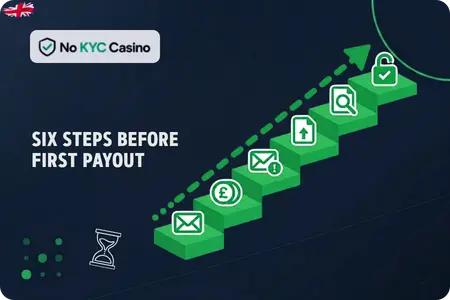
- Email registration. Sign up with email and password, no documents asked at the gate. Most operators activate the account inside a minute and let you head to the cashier straight away.
- Deposit and play. Fund the account with your card, e-wallet, or bank transfer, and start spinning or betting with no verification check standing in the way. Some casinos run a soft credit check in the background, invisible to the player.
- Withdrawal request triggers KYC email. The first time you ask for a payout, the cashier pauses and the casino emails a verification request. This is the gate where the document chain kicks in.
- Document upload. ID, proof of address, and proof of payment method go through the casino’s secure upload portal. Source of funds joins the pack if the cashout sits above the AML threshold for that operator.
- Review period. A compliance team checks each document against AML and operator rules, with most reviews landing within 24-72 hours. Mismatched names, expired documents, or low-quality scans extend the review and prompt a re-upload request.
- Approval and payout. Once the file is cleared, the account is marked verified and the original cashout is released through the chosen payment method. Subsequent withdrawals usually skip the document step, though crossing AML thresholds or returning after a long pause can trigger a fresh review.
The full sequence sits between sign-up and the first wired payout, and most players hit it without warning at the cashier. Six steps before money moves. A no KYC online casino collapses this chain into a single step or removes it entirely on standard cashouts. The next section unpacks how the no verification casino side cuts this six-step path down to one or none.
Anonymity in Online Gambling: What Privacy UK Players Get

We mapped how anonymity plays out at a no KYC site, and the answer is a spectrum, not a switch. Anonymous gambling here means reduced personal data on file, with the minimum kept for account access and the payment rails to function. A scale, not a vanishing act. Three levels show up across the operators on this page, each with its own trade-offs.
Complete Anonymity: Wallet-Based Access
The deepest privacy tier skips traditional accounts altogether. An anonymous casino running this model uses wallet-based registration: you connect a crypto wallet (MetaMask, Phantom, or similar) instead of creating a username, email, or password. No account, no email, no password. Deposits and cashouts move directly between your wallet and the casino’s smart contract, with play starting the moment a transaction confirms on the blockchain.
Partial Anonymity: Email Registration Only
Most UK players land in this tier on no KYC sites. Sign-up takes an email and a password, nothing more, with no documents requested at the gate or after a standard payout. Minimal data, full access. The platform stores just enough to handle account recovery, bonus tracking, loyalty points, and basic anti-fraud signals.
Conditional KYC: Verification for Large Withdrawals
The third tier kicks in only under specific triggers, not at sign-up. Documents may be requested when a payout crosses an AML threshold, around 2000-5000 GBP per current T&C, or when account activity matches an internal risk flag. Triggered, not required upfront. The point of conditional KYC is meeting international AML obligations, not gating ordinary play.
How Online Casinos Let You Play with No KYC

We ran the mechanism behind every No KYC Casino on this page, and the answer comes down to two layers: an offshore licence (Anjouan, Curaçao, or similar) that permits risk-based verification, and a payment stack running on crypto rails. Two layers, two jobs. A blockchain casino runs an automatic identity check at every transaction, which is why standard cashouts can clear without a single document.
Account Registration Without ID
The flow below covers the standard email path on most no KYC platforms. Wallet-based sign-up skips straight to step 4 once the wallet is connected.
- Start the sign-up
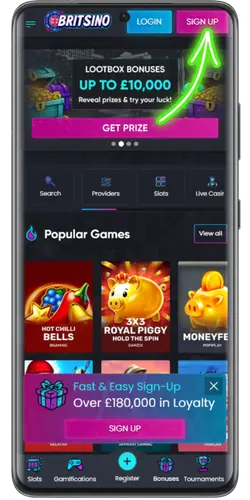
Tap the Sign Up button in the top-right of the casino homepage. Most operators highlight the button in a contrasting colour, making it the first thing visible above the fold on mobile.
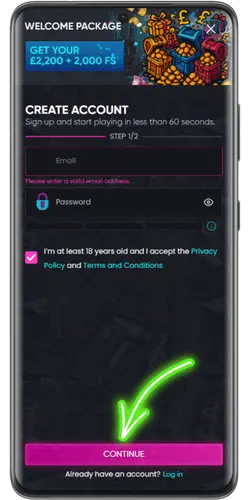
- Create your login
Enter your email and a strong password, then tick the box confirming you are 18 or over and accept the terms. No documents at this stage. Tap Continue to move forward.
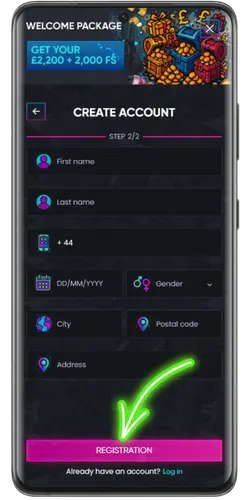
- Fill in your details
On many platforms, the second screen asks for basic personal details (name, address, phone, date of birth). This is not document KYC. The data sits on file for account recovery and AML risk signals. Cleaner no KYC sites skip this screen entirely.
- Head to the cashier
Once the account is live, the homepage refreshes with a Deposit button in the top corner. Tap it to open the payment menu.

- Pick your deposit method
The cashier lists the full payment menu: cards, e-wallets, and crypto (Bitcoin, Ethereum, Litecoin, USDT, and others). Pick the one that matches your privacy preference and follow the on-screen prompts to fund the account.
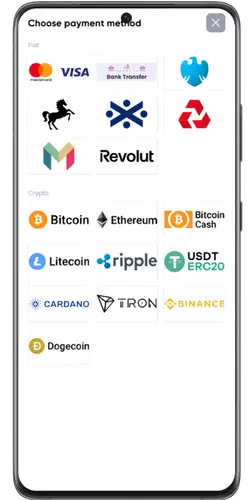
Deposit Options at No Verification Sites
Crypto sits at the centre of the cashier on a no verification casino, with fiat options playing a supporting role. Bitcoin, Ethereum, Litecoin, Solana, and stablecoins like USDT cover most deposit menus, with minimums usually starting around the equivalent of £10 to £20. Two confirmations, deposit cleared. A BTC deposit casino confirms funds within one or two block confirmations, while gift cards and select e-wallets appear at some operators as fiat-friendly alternatives.
Withdrawal Process Without Verification
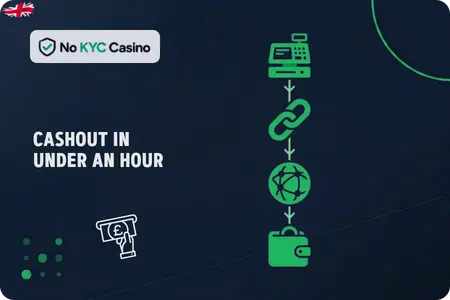
We timed cashouts on every brand on this page and the standard flow finishes inside 60 minutes on crypto rails. Inside 60 minutes, no documents. The route below is what an instant withdrawal No KYC Casino looks like in practice, with no upload pause along the way.
- Sign in to the casino using the email and password from registration, or reconnect the Web3 wallet used at sign-up.
- Clear active bonus wagering first since most operators block payouts while bonus turnover is unfinished.
- Open Cashier and pick Withdrawals from the side menu, then check the minimum and maximum limits for the chosen payment method.
- Choose method and network carefully since stablecoins like USDT exist on multiple chains (ERC-20, TRC-20, BEP-20, and others), and Bitcoin can run on the standard chain or Lightning. Pick the network that matches your receiving wallet.
- Enter the amount and wallet address that supports the chosen network, then double-check the address character by character since crypto transfers cannot be reversed.
- Confirm the request and wait for the operator to release the transaction. Standard crypto cashouts land between 1 and 60 minutes after the network broadcast.
The single point where things slow down is the AML threshold, where conditional KYC may step in for unusually large payouts. Hands-off below the threshold. Below that line, the standard crypto payout clears automatically, with the casino’s compliance system reading blockchain risk signals instead of asking the player to upload anything.
What Games Are Available at No KYC Casinos

We filtered the game library at every No KYC Casino on this page, and the catalogue mostly mirrors what UK players already know from regulated sites. Slots, table games, and live dealer rooms run on the same provider tech in both worlds. The gap is in the extras. No KYC sites add a category that UKGC platforms cannot host: provably fair crypto games verified through the blockchain itself.
Anonymous Slots and Table Games
Slots and table games at a no KYC site come from the same studios that supply UKGC casinos, with identical RTP percentages on the most popular titles. Same studios, same RTP. Standard Starburst sits at 96% on both ecosystems, and the library on a typical operator runs from 2000 to 10,000+ titles depending on how many providers the platform runs. Looking for the best Bitcoin casino no KYC has more to do with breadth of catalogue than with provider differences.
- Pragmatic Play: widest catalogue with mobile-first releases, dominant in the no KYC space. Look for Sweet Bonanza, Gates of Olympus, and Big Bass titles in nearly every operator menu.
- NetEnt: long-running studio behind UK favourites Starburst and Gonzo’s Quest. Their releases keep the highest RTP averages in the industry, often above 96%.
- Microgaming: the largest progressive jackpot network online (Mega Moolah). Wins on the network can hit seven figures, with payouts processed through the same crypto rails as standard cashouts.
- Play’n GO: Scandinavian-style slots, best known for Book of Dead. Their catalogue leans heavily on Egyptian and treasure-hunt themes with bonus-buy features now standard.
- Hacksaw Gaming: high-volatility, crypto-friendly slots that became standard at offshore brands. Cult titles like Wanted Dead or a Wild attract players hunting big multipliers in short sessions.
Table game cabinets cover blackjack, roulette, baccarat, poker, and craps. Stake limits run from £0.10 on entry tables up to £10,000+ on VIP versions. Same maths, same odds. The provider tech that powers UK regulated casinos runs the engine underneath, so house edges and rule sets stay consistent across offshore and onshore worlds.
Live Dealer Without ID Verification
Live dealer rooms at a no KYC site come from the same handful of studios that power UK regulated platforms, with real croupiers streaming from licensed European facilities. The chat function, the camera angles, and the side-bet menus all work the same way across both ecosystems. Same dealers, no documents.
Top studios behind no KYC live dealer rooms:

- Evolution: market leader, runs Crazy Time, Lightning Roulette, and the bulk of high-RTP live tables. Their game shows pull the largest concurrent player counts in the live segment, often 10,000+ at peak hours.
- Pragmatic Play Live: fastest-growing studio with strong mobile-first UI and Mega Wheel game shows. Tables run on lower latency than most competitors, useful for in-play side bets that need quick reflexes.
- Ezugi: established Asian-market provider, popular for Speed Roulette and authentic-feel blackjack. Their tables often carry lower minimum bets than Evolution, suitable for testing strategies before scaling up.
- Authentic Gaming: smaller catalogue centred on streams from real Maltese and Latvian land-based casinos. Players see an actual physical wheel or table, not a studio set. A clear draw for traditionalists.
Studios run from licensed facilities in Malta, Latvia, and Romania, with the same RNG audits and game integrity protocols that operate behind regulated live tables. Live blackjack, roulette, baccarat, and game-show formats like Crazy Time fill the standard menu.
Provably Fair Crypto Games
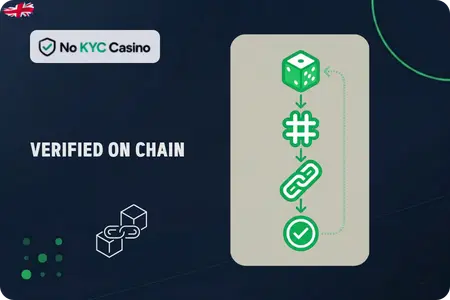
Provably fair games are the category that separates a no KYC crypto casino from anything on the UKGC track. Every round runs on a transparent algorithm, with the casino’s seed and the player’s seed combining to produce an outcome that anyone can verify on the blockchain afterwards. Verifiable, not trust-based. This removes the classic “casino-says-so” question entirely.
- Crash: bet rises with a multiplier curve, cash out before the curve breaks at a random point. Pre-set auto-cashout features allow strategies based on fixed multipliers, useful for managing volatility.
- Plinko: drop a chip through a peg field, payout depends on which slot it lands in at the bottom. Risk levels are usually adjustable across low, medium, and high settings, changing payout distributions on the fly.
- Dice: bet over or under a chosen number, with payout scaling against probability. The simplest provably fair format, popular for quick verification of the algorithm by sceptical players.
- Mines: reveal tiles on a hidden grid, avoid the bombs, bank winnings before pushing further. Multiplier grows with each safe tile, with grid size and mine count fully configurable before each round.
- Limbo: pick a target multiplier, win if the random multiplier lands above the chosen point. Higher targets pay bigger but trigger far less often, ideal for bankroll-management testing on small stakes.
Studios behind these formats are crypto-native: Spribe, BGaming, and Hacksaw push out the bulk of the catalogue, often with custom mobile UIs. Every result hash gets posted to a public ledger, which means a player can audit any round long after the session has ended. Auditable rounds, public ledger.
Sports Betting at No KYC Sites
Sportsbooks at no KYC operators run on international markets without the UK Gambling Commission affordability checks that limit stakes on regulated platforms. Football, tennis, basketball, ice hockey, cricket, and esports cover the standard menu, with 30 to 40+ sports listed at the larger brands. International coverage, fewer caps.
| No KYC Sportsbook | UK Regulated Bookmaker |
| Sign-up: email or wallet, 60 sec | Sign-up: ID verification |
| Affordability: none on standard play | Affordability: above £125 monthly |
| Stake limits: uncapped | Stake limits: profile-based caps |
| In-play: lower divisions and obscure leagues | In-play: mostly top-tier markets |
| Cashout: minutes via crypto | Cashout: hours-days via bank |
The trade-off is the same one that runs across the rest of the no KYC space: less paperwork and bigger limits at the cost of UK-side player protections. Players who like to bet on niche leagues benefit most from the wider book.
What Bonuses Can You Claim at No KYC Casinos

We compared bonus structures across every operator on this page against the UK-regulated benchmark, and the split is clear: bigger headline offers, tougher wagering. Welcome packs reach further on offshore platforms, with WR (wagering requirements) typically sitting between 60x and 80x, against 30x to 40x on the UKGC track. Bigger offer, stricter playthrough. The four bonus types below cover what most players meet at sign-up and after.
Welcome Bonuses
Welcome bonuses are the headline offer at every operator, and the format is a match deposit on first funding. Standard rates run from 100% to 500% of the first deposit, with caps that reach the equivalent of one full Bitcoin or higher on the most generous brands. More upside, more turnover. Free spins on selected slots often join the match offer, with separate WR rules on the spin winnings.
| No KYC Casino | UKGC Casino |
| Match rate: 100% to 500% | Match rate: 100% to 200% |
| Bonus cap: up to 1 BTC equivalent | Bonus cap: usually £100 to £500 |
| WR: 60x to 80x on bonus | WR: 30x to 40x on bonus |
| Time to clear WR: 7 to 30 days | Time to clear WR: 14 to 30 days |
Read the WR before deciding which welcome to chase. A bigger headline offer paired with 80x WR can clear less withdrawable cash than a smaller bonus at 40x. Maths beats headline numbers. Free spins on selected slots and the £5 max-bet cap during wagering apply on both tracks. The difference shows up most clearly on bonuses worth £500+ in match value.
No Deposit Bonuses for Anonymous Players
No deposit bonuses are the smallest category by size, with offers usually sitting between £5 and £20 equivalent in crypto. The point is to let a player test the platform without funding the account, which is rare at UKGC sites but standard on offshore brands. No risk, full test.
A No KYC Casino no deposit bonus rarely comes without strings: WR sits higher than match bonuses, often 70x to 100x, and max cashout caps usually limit conversion to £50-100 even on winning spins. Higher WR, capped payouts. A no KYC crypto casino no deposit bonus is usually credited in fractional BTC or USDT instead of fiat, making it a fully no deposit crypto offer.
Reload Bonuses and Cashback
Reload bonuses and cashback live in the same retention category at No KYC Casinos: both reward existing players rather than new ones, but the mechanics work differently. Reload is a smaller match (usually 25% to 75%) on subsequent deposits, while cashback is a percentage return on net losses over a defined period. Same goal, different formulas.
| Reload Bonus | Cashback |
| When credited: after deposit | When credited: after period of net losses |
| Size: 25% to 75% of deposit | Size: 5% to 25% of net losses |
| WR: 30x to 50x | WR: 1x to 5x, sometimes wager-free |
| Frequency: weekly or monthly | Frequency: weekly, monthly, or daily |
| Trigger: player deposit | Trigger: auto-calculated by operator |
| Best for: topping up after wins | Best for: recovery after a losing session |
Cashback is the more player-friendly of the two on a maths basis, since the WR is far lower and the cashback amount sits as withdrawable in many cases. Reload pulls bigger upfront numbers but rarely lands net positive without sustained playthrough. Cashback wins on maths.
VIP Programmes
VIP programmes at No KYC Casinos run on the same engagement maths as UKGC equivalents, with tiers climbing based on cumulative deposits, total wagered, or both. The top of the ladder is where the different benefits kick in, with personal account managers, custom limits, and crypto-native perks that UKGC platforms cannot offer. Crypto perks change the picture.
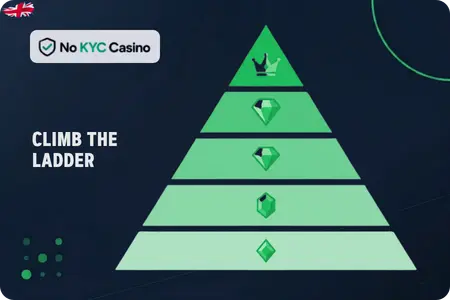
- Bronze (entry). Automatic on first deposit, with a small cashback (1-3%) and basic level-up bonuses.
- Silver. Higher cashback (3-7%), priority support, and birthday bonus credits. Typically requires £500 to £2000 cumulative deposits.
- Gold. Personal account manager assigned, tier-only promotions, faster cashout windows. Cashback hits 7-12% at most operators.
- Platinum. Bespoke bonus deals, invite-only tournaments, higher-stake table access. Cashback 12-18%, with crypto-only drops like NFTs at top brands.
- Diamond / Black (top). Negotiable terms on everything (bonuses, limits, cashout speeds), white-glove account management. Cashback up to 25%, plus invitations to physical events.
Crypto VIP tiers occasionally throw in extras unique to the offshore space, such as token payouts on operator-run platforms, NFT-based loyalty assets, or revenue-share programmes for high-volume players. Each brings long-term value beyond the straight cashback figure.
Best Payment Methods at No KYC Casinos

We pulled the cashier menus from every crypto casino no KYC platform on this page, and the picture splits into three clean categories: crypto, gift and prepaid cards, and e-wallets. Each one carries a different privacy profile, a different speed, and a different ceiling on what it can do. Method sets the privacy ceiling. The breakdown below covers how each one behaves at sign-up and on standard cashouts.
Cryptocurrency Options
Cryptocurrency is the default rail on every no KYC platform, with deposit menus typically running five staple coins. BTC remains the most-supported entry, while stablecoins and faster altcoins increasingly drive day-to-day cashouts thanks to lower fees and quicker confirmations. Five coins cover most cashiers. The trade-offs sit in fees and speed.
| Coin | Speed and fee |
| Bitcoin (BTC) | 10-60 min, £1 to £5 |
| Ethereum (ETH) | 5-30 min, £2 to £15 gas |
| Litecoin (LTC) | 5-20 min, under £0.50 |
| Solana (SOL) | Under 1 min, pennies |
| Tether (USDT) | 5-30 min, lowest on TRC-20 |
A Bitcoin casino no KYC operator typically lists all five coins in the menu. BTC works best for conservative players who value the widest acceptance, ETH suits DeFi-experienced users on smart contract casinos, while LTC and SOL appeal to frequent small cashouts where speed and low fees matter. A USDT casino setup has become a standard fixture for bonus-clearing sessions, since the value stays anchored to the dollar between deposit and cashout. Match coin to use case. Pick the one that fits your need, not the hype.
Gift and Prepaid Cards

Gift and prepaid cards are the smallest of the three categories, but they fill a specific niche for players who want fiat-funded play without a bank link. No bank, no credit check. Services like Paysafecard, AstroPay, and Flexepin let a player load a fixed amount on a voucher at a corner shop or online retailer, then redeem the voucher at the cashier in seconds. The catch is that gift cards usually work for deposits only, with cashouts routed back through crypto or e-wallets.
E-Wallets
E-wallets cover a wide range at no KYC platforms, but the privacy story depends entirely on which wallet sits behind the deposit button. Standard fiat e-wallets carry their own verification layer separate from the casino, while crypto-native wallets bypass identity systems altogether. Privacy follows the wallet.
Three distinct categories show up across no KYC cashiers:
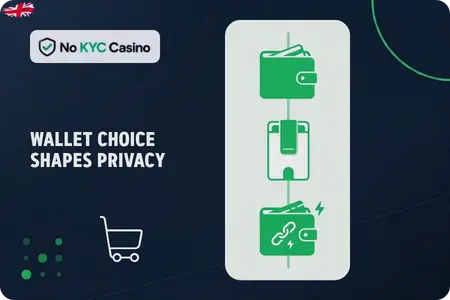
- Established fiat wallets. PayPal, Neteller, and Skrill come with their own KYC layer that the casino does not control. Privacy at the casino level is high, but the wallet provider still holds full identity data. Withdrawals typically clear within a working day, with the highest limits among the three categories.
- Lightweight verification wallets. MiFinity, Jeton, and similar services run lighter checks, usually email plus phone number, with no document upload for standard accounts. A practical middle ground for players who want fiat funding without heavy documentation. Cashouts usually take 12 to 48 hours, with mid-range limits below the major fiat wallets.
- Web3 / crypto wallets. MetaMask, Trust Wallet, and similar browser wallets connect directly to no KYC sites with no account at the wallet level. Full anonymity, but limited to crypto-native casinos. Payouts settle at blockchain speed, with no operator-side caps on standard amounts.
The three tiers map cleanly onto the privacy trade-off seen across the whole no KYC space. Heavier brand recognition usually means more data on file with the wallet provider, while lighter or crypto-based options keep the data footprint slimmer. The wallet keeps the record.
Payment Methods Compared
All three categories sit side by side at most no KYC platforms, with the choice coming down to speed, privacy, and acceptance breadth. The table below lines them up on the two metrics that matter most in 2026, with deposit speed staying near instant across crypto and e-wallets.
| Method | Speed and privacy |
| Bitcoin (BTC) | 10-60 min, high privacy |
| Ethereum (ETH) | 5-30 min, high privacy |
| Litecoin (LTC) | 5-20 min, high privacy |
| Solana (SOL) | Under 1 min, high privacy |
| Tether (USDT) | 5-30 min, high privacy |
| Web3 wallets | 1-30 min, very high privacy |
| Fiat e-wallets | 1-24 h, medium privacy |
| Gift / prepaid cards | Not supported (deposit only), high privacy |
| Wire transfer | 3-7 days, low privacy |
A no KYC Bitcoin casino remains the fastest standard route for high-volume cashouts, with the crypto withdrawal casino model clearing inside the same hour-window on most operators. Crypto leads on speed. Gift cards and fiat e-wallets stay viable for deposits, but cashouts route back through crypto channels by default, and wire transfers stay on a different timeline altogether.
Are No KYC Casinos Legal in the UK?
We checked the licensing status of every offshore casino on this page, and for UK players accessing these sites is not illegal, even though the operators sit outside UKGC jurisdiction. They run under Curaçao, Anjouan, or similar regulators that permit no KYC operations and fall outside the GamStop self-exclusion framework. Legal access, outside UK regulation. A no GamStop casino sits in the same regulatory bracket by definition, since GamStop only enforces against UKGC-licensed brands.
Curacao vs Anjouan vs UKGC Licensing
Three licensing bodies dominate the no KYC space: Curaçao, Anjouan, and Malta. A Curaçao license has been the offshore standard since the 1990s, while an Anjouan license has gained ground since 2024 as a crypto-friendly framework with lighter operational rules. Malta sits between the two on strictness, still offshore from the UKGC perspective. Three regulators, three rule sets. The table sets the practical differences against the UKGC benchmark.
| No KYC (Offshore) | UKGC Casino |
| KYC on sign-up: no | KYC on sign-up: yes |
| Withdrawal: 1-60 min | Withdrawal: 24-72 h |
| Disputes: direct with operator | Disputes: full UKGC arbitration |
| GamStop: not covered | GamStop: covered |
| Crypto payments: yes | Crypto payments: rarely supported |
| Game restrictions: minimal | Game restrictions: strict (UK Gambling Act) |
The table makes the trade-off plain: faster operations and crypto support on one side, regulatory protection and formal complaint channels on the other. UKGC-licensed casinos remain the only route with full UK-side player protection and access to GamStop. No KYC sites lean on speed and privacy in return. Legality clear, safety next. The next section walks through what staying safe looks like on an offshore platform.
Are No KYC Casinos in the UK Safe?
We verified the security setup at every No KYC Casino on this page, and the picture for UK players is positive when the platform sits on a reputable licence with a track record. Safety on offshore sites depends less on the regulator and more on what the operator builds in. Solid licence, solid build. The five protections below cover what serious brands run by default.
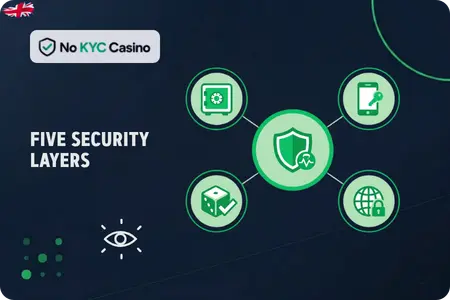
- Cold Wallet Storage. The majority of player funds sits in offline cold wallets, with only hot-wallet balances exposed online. The split limits the platform’s exposure if the live cashier system is ever compromised.
- Two-Factor Authentication (2FA). Email or authenticator-app codes add a second login step on top of the password. Standard at every serious brand, optional at the player’s choice but worth enabling on day one.
- Provably Fair Technology. The provably fair games category lets players verify each round’s outcome on the blockchain, removing any ability to manipulate results behind the scenes.
- SSL Encryption. End-to-end SSL protects every connection between the player’s browser and the casino servers, the same encryption banks use for online portals.
- Anti-Fraud Systems. Pattern-monitoring tools flag unusual behaviour (multi-account creation, IP mismatches, abnormal bet sizing), protecting both honest players and the site’s reputation.
The five protections above sit at the baseline of any serious no KYC operator on this page, with missing items being the clearest signal to walk away. Five protections, non-negotiable. Reputable brands run all five by default. The rest treat them as optional.
Safety Tips for No KYC Casino Players
The protections above sit on the operator’s side. What follows is the player’s checklist for offshore platforms: five habits that head off most avoidable problems before they start.
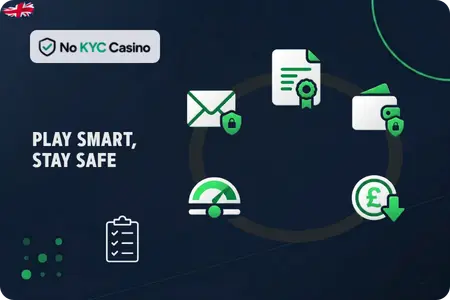
- Check the licence first. Confirm the brand runs under Curaçao, Anjouan, or Malta authority, with the licence number visible in the site footer and the T&Cs published in plain language. A missing or hidden licence is the clearest warning sign at first glance.
- Set up secure payment hygiene. Use crypto wallets protected by 2FA, hardware wallet storage for larger balances, and e-wallets or prepaid vouchers as second-line options. Never reuse a wallet that has been linked to other identity-heavy services.
- Check the withdrawal policy first. Look for the maximum cashout per request, the AML threshold where conditional KYC triggers, and whether the platform caps withdrawals on bonus winnings. Most disputes trace back to a missed clause here.
- Set deposit and loss limits. Every reputable platform offers built-in responsible gaming tools (deposit limits, loss limits, session timers, cooling-off periods). Set them on day one, before the first deposit, while the decision is calm.
- Use official channels for documents. If the platform ever requests verification documents on a large payout, upload them through the in-account portal only. A No KYC Casino UK player should never send ID images via live chat, email, or third-party messengers, even if the request looks official.
A reputable platform plus a careful player is the combination that makes the offshore route work without surprises. Most safety problems are preventable. Nothing on the list above takes more than five minutes to set up, and every step pays for itself the moment a payout clears without a hitch. Why players make that trade-off in the first place comes apart in the next section.
Why Play at No KYC Casinos?

We weighed the practical reasons UK players move to a no KYC online casino in 2026, and three benefits stand out across the board. Anonymous gambling delivers a cleaner data footprint, faster timings at both ends of a session, and a wider game library than the UK-regulated track allows. Three benefits, one platform type. Each one breaks down across the H3s below, with the practical detail behind every claim.
Anonymity and Data Privacy
The privacy angle is the leading reason most players try a no KYC site in the first place. An anonymous casino does not store passport scans, selfies, proof of address, source-of-funds documents, or any of the identity pack that UK-regulated sites hold by default. Reduced footprint, fewer leaks. A privacy casino keeps the minimum required for account access and payment processing, with nothing forwarded to third-party verification services or stored in a central identity database.
Speed of Registration and Payouts
The time savings show up at both ends of a session. Registration finishes in under 60 seconds via email-and-password or a Web3 wallet connection, while crypto withdrawals clear in 5 to 60 minutes through the standard cashier flow. Regulated bank transfers and full document verification sit on a different timeline entirely. Minutes, not days.
| No KYC Casino | UKGC Casino |
| Sign-up: under 60 sec | Sign-up: 5-15 min plus documents |
| First withdrawal: 5-60 min | First withdrawal: 24-72 h with verification |
| Weekend: same as weekdays | Weekend: bank cutoff applies |
Crypto cashouts also keep running outside banking hours, which means an instant crypto payout on a Sunday night clears at the same speed as one at noon on Tuesday. Blockchain ignores the weekend. The network settles continuously regardless of weekday, weekend, or bank holiday, so a regulated bank cutoff has no effect on a crypto payout.
Broader Game Library
The catalogue at offshore sites pulls from international studios that UK-licensed operators cannot host. Extra slots, provably fair crypto games, and a sportsbook stretching well past UK-regulated coverage are all on the menu. UK-specific player protection rules also do not apply, which changes how the games themselves behave at the cabinet level. Wider catalogue, fewer caps.
UK-specific restrictions that do not apply at no KYC sites:
- The £2 maximum spin cap. The Commission introduced a £2 cap on slot spins in late 2024. Offshore brands apply no such limit, with high-volatility players able to use full betting ranges.
- Autoplay restriction. UK-licensed slots disabled autoplay in 2021. Offshore catalogues keep autoplay live with configurable session lengths and loss-stop settings.
- Slot speed minimum. UK rules enforce a 2.5-second minimum spin time. Offshore titles run on provider-default speeds, often faster.
- Affordability checks above £125. Regulated operators trigger affordability documentation once monthly losses cross this threshold. The offshore route applies no equivalent check on standard play.
The trade-off is the same that runs through the whole no KYC route. UK regulatory protections sit on one side, while the offshore catalogue offers wider mechanics and fewer caps on the other. Players decide which side fits their priorities, and the next section walks through the downsides of choosing the offshore route.
Disadvantages of No KYC Casinos
We opened up the trade-offs that come with the no KYC route, with no marketing polish on the answer. A casino no KYC setup brings real benefits, and it also brings real downsides that any player should understand before depositing. Four downsides worth knowing. The list below covers the four areas where offshore platforms fall short of the regulated alternative.
Limited Player Protection
The most visible downside on the offshore route is the loss of UKGC dispute resolution. An offshore casino sits outside the UK Gambling Commission framework, which means a complaint about an unpaid cashout or a frozen account has no formal regulator to escalate to. Operator goodwill, not regulator force. Resolution depends on the brand’s own complaint process and market reputation.
Sudden KYC Requirements
The marketing label “no KYC” describes the standard flow, not every possible scenario. Conditional KYC sits in the background at every offshore platform that handles fiat-equivalent volumes, and it can be triggered without warning when a session matches specific patterns. Default no, conditional by design. The most common triggers are predictable, and most are avoidable.
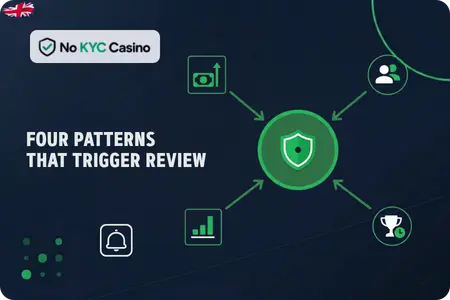
- Large payout above threshold. Withdrawing the equivalent of 2000-5000 GBP per current T&C in a single request triggers an automatic compliance review. Plan large cashouts knowing that documentation may be requested at the highest tier.
- Pattern of multi-account behaviour. Sites flag accounts that share an IP, a device fingerprint, or a wallet with another existing account. One account per platform, one device, one wallet keeps this flag inactive.
- Sharp shift in deposit pattern. A long-quiet account suddenly depositing large amounts triggers a “source of funds” risk flag. Gradual ramp-up reads as natural to compliance teams, while sudden spikes raise immediate questions.
- Big win, minimal play. Cashing out a large bonus win after minimal play triggers a bonus-abuse review at most brands. Standard playthrough beyond the WR usually clears the flag.
The same patterns trigger reviews at UKGC sites too, but on offshore platforms the review happens with a single platform’s compliance team rather than against a regulator’s framework. Plan deposits and withdrawals around these triggers and conditional KYC stays inactive.
Account Recovery Challenges
Less data on file is the privacy win and the recovery weakness at the same time. A standard no KYC account holds the player’s email and password and not much else, which means losing access to either one leaves no proof of ownership to fall back on. Minimal data, minimal recovery options. The list below covers the practical safeguards.
Safeguards against account recovery problems:
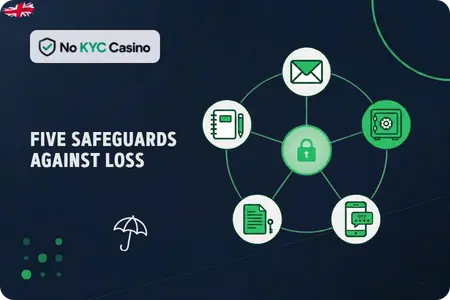
- Use a separate email. Set up an email account just for the casino, with a strong password and 2FA enabled. Never reuse this email for newsletters or sign-ups elsewhere.
- Use a password manager. Store the casino password in a password manager (Bitwarden, 1Password, or similar). Never rely on browser-saved passwords, which can vanish with a cache clear.
- Backup the 2FA codes. When enabling 2FA, save the recovery codes in a secure location (encrypted note, hardware password manager). Losing the 2FA device without backup codes locks the account.
- Protect the wallet seed phrase. For Web3 wallet sign-up, write the 12-word or 24-word seed phrase on paper or steel and store it offline. Never store it in a cloud document, screenshot, or browser autofill.
- Keep a small recovery log. Note the casino name, sign-up date, email used, and wallet address (if used) in a personal record. If something goes wrong, support teams need this minimum information to verify ownership.
The same precautions apply to any privacy-focused service, but they matter most when the account holds value. A short setup session prevents most permanent-loss scenarios that recovery teams cannot fix.
Money Laundering Concerns
Anonymous platforms attract regulatory attention by design, and not every offshore brand passes the test. A small number of platforms have been shut down for AML failures over the past three years, with player funds frozen or lost as a result. Operator AML matters more than label. Compliance-conscious brands publish their AML policies openly.
- Public AML policy on site.Look for a standalone AML or “Anti-Money Laundering” page linked from the footer. A missing or hard-to-find policy is a warning sign.
- Source-of-funds procedure documented. Reputable brands explain when and how they may request source-of-funds proof on large withdrawals, with specific thresholds named in the T&Cs.
- Compliance officer named or referenced. Strong brands name a compliance officer or department in their public-facing terms, often with a direct email contact.
- Operating history of 12+ months. Brands that have run for over a year without major incidents have passed at least one regulatory cycle on their licence. Newer entrants carry higher compliance risk until they build a track record.
The four signs above do not guarantee zero risk, but a brand that fails on all four is the wrong choice for a UK player. The criteria we use to rank the platforms on this page lean heavily on the same compliance markers, set out in detail in the next section.
Our Standards for No KYC Casinos

We audited every No KYC Casino on this page, with a process that goes beyond comparing speed numbers. Picking a no ID casino is a question of reliability, usability, and accountability working in the same direction at the same brand. Four criteria, hard cut. The standards below describe what each operator must clear before the platform appears in the ranking above.
No KYC During Money Withdrawal
The cleanest test is whether a player can complete a standard withdrawal without uploading a single document. Sites that demand verification on every cashout, regardless of size, are filtered out at this stage and never reach the ranking. Conditional KYC on payouts above the AML threshold is acceptable. Standard withdrawals, no documents.
- KYC required on first cashout. Verification before the player can withdraw anything is the strongest signal that “no KYC” is a marketing label, not a working flow.
- Document upload prompts during sign-up. Asking for ID at registration, even with “optional” framing, breaks the standard no KYC promise from day one.
- Hidden KYC clauses in T&Cs. Vague wording like “verification may be required at our discretion” without a clear AML threshold lets the operator request documents on any payout.
- Different limits for verified accounts. Tiered withdrawal caps that raise only after document upload turn “no KYC” into a soft pressure tactic rather than a clean policy.
A platform passes this stage when the standard cashout flow runs end-to-end without a single document request. Anything else means conditional KYC is wired into the default behaviour, not held in reserve.
Instant and Easy Payout Process
The payout flow is where a no KYC platform earns its rating or loses it. The benchmark we used was first-cashout windows on every site here, measured on standard amounts well below AML thresholds, with the timer starting at request submission and ending when funds landed on-chain or in the destination wallet. Sub-60-minute crypto payouts score higher. Fast withdrawal crypto rails set the baseline.
Reputation and Transparent Terms
Reputation moves slower than marketing, which makes it the most reliable single indicator at the operator level. The shortlist for this page only includes brands with at least 12 months of operating history, with no major dispute records on independent player forums, and with a verifiable Curacao license or equivalent visible in the site footer. Track record beats brand polish.
- Ownership transparency. Parent company named in the footer, with a registered address that can be cross-checked against the licence record.
- Independent forum review. Active threads on Reddit, AskGamblers, or Casinomeister over the past year, with visible signs of how the operator handles complaints.
- Dispute record. Zero unresolved formal complaints over the same period, or visible operator engagement on the ones that surfaced.
- Licence document accessible. A clickable link to the actual licence certificate (Curacao, Anjouan, or Malta), not just a static badge image.
- Published T&Cs in plain language. WR rules, max bet caps, restricted games, and withdrawal limits all visible in the site terms without requiring sign-up.
A brand that clears all five checks has earned the right to be considered, but reputation is reassessed every quarter on this page. A new dispute pattern or licence change can drop a platform from the ranking between updates.
Payment Methods That Suit No ID
A no ID casino needs a payment menu that matches the privacy promise on both sides of the cashier. The minimum standard for this page is BTC plus ETH plus one e-wallet option, with all three live for deposits AND withdrawals. Crypto-only on deposits with no crypto-out flow is a disqualifier. Two-way crypto, non-negotiable.
- Crypto-in, fiat-out only. Accepting crypto deposits but only releasing funds via bank transfer breaks the no ID flow at the cashout end.
- Single-coin support. Sites listing only one cryptocurrency (usually BTC) lack the redundancy needed when network fees spike or one chain experiences delays.
- No e-wallet alternative. A crypto-only cashier without at least one e-wallet or prepaid voucher option leaves fiat-funded players with no entry route.
- Withdrawal-only KYC on certain methods. Asymmetric verification rules (some methods require ID at cashout while others do not) undermine the platform-level privacy promise.
These four standards together cut the long list of candidate platforms down to the ranking at the top of this page. Four criteria, full audit. The best no KYC casino options below have all cleared every check, with regular re-checks on payout speeds and listing transparency to keep the page current.
Gambling Responsibly at No ID Casinos
Privacy at sign-up still leaves the responsible gaming toolkit intact. Most no KYC casinos build in the same safeguards as UKGC operators, accessible through the player dashboard or via support chat. A no ID casino setup still includes deposit limits, time-outs, and other controls that work without identity verification. Same tools, anonymously.
Four responsible gaming tools built into most no KYC platforms:
- Session reminders. Periodic pop-ups during play showing the current session duration, cumulative wagered amount, and net position. Enabled on most platforms by default, with the option to set the reminder interval.
- Time-outs. Temporary account cool-off periods, configurable from 24 hours up to one week. Triggered from the account settings, with the platform blocking login and deposit attempts until the period expires.
- Deposit and loss limits. Daily, weekly, and monthly caps on either deposit amount or total losses. Once set, limits cannot be loosened without a wait period (usually 24-72 hours), only tightened immediately.
- Self-exclusion options. Long-term account blocks tied to the registered email and other account identifiers. Self-exclusion crypto features at some platforms also flag the deposit wallet, with periods ranging from 30 days to permanent.
GamStop covers UKGC sites only. Blocking access to offshore platforms requires individual self-exclusion at each no KYC site. All gambling carries financial risk, and these platforms are restricted to players aged 18 and over.


No KYC Casinos in the UK FAQ
Accessing offshore platforms is not illegal for UK players, but no KYC casino operators sit outside UKGC jurisdiction. Enforcement targets operators, not individual players, with no UK-specific penalty for using offshore sites. Disputes go direct to the operator and, where one exists, the offshore licensing body.
Gambling winnings are tax-free for casual UK players under current HMRC rules, whether the platform is UKGC-licensed or offshore. The same applies to crypto winnings paid out as crypto, but converting them to fiat may create a capital gains event above the annual allowance. Professional gamblers (primary income from betting) fall under different HMRC rules and should consult a tax adviser.
VPN usage typically does not breach UK law, but the operator’s T&Cs are the deciding factor. Some offshore brands explicitly allow VPN traffic, while others void winnings if VPN use is spotted during play or at cashout. Read the specific terms before connecting, especially clauses on “permitted jurisdictions” and “circumvention of geo-blocks”.
Partial anonymity is possible through gift cards (Paysafecard, AstroPay) or lightweight e-wallets (MiFinity, Jeton) at some operators, but cashouts route back through crypto by default. Fully crypto-free anonymity is becoming rare, since most no KYC platforms treat crypto as the standard privacy rail. Bank transfers and standard cards trigger verification at every operator.
Yes. Welcome bonuses, no deposit offers, reload bonuses, cashback, and VIP programmes show up at every no KYC platform on this page. The catch is tougher wagering, typically 60x to 80x against 30x to 40x on UKGC sites, so the headline match figure tells only part of the picture.
The standard flow is email plus password or wallet connection at sign-up, no document upload. Behind the scenes, blockchain analytics and basic risk signals (device, IP, deposit pattern) flag accounts when something looks off. Documents only enter the picture if conditional KYC kicks in above the AML payout threshold.
Four main risks: no UKGC dispute resolution, conditional KYC triggers on large payouts, harder account recovery if email or wallet access is lost, and exposure to platforms that may face AML enforcement. Each is manageable with operator choice and account hygiene, but none disappears on the offshore route.
Standard cashouts below the AML threshold (£2,000 to £5,000 per single request) clear without document upload at every no KYC platform on this page. Single payouts above that line trigger conditional KYC, with document review adding 24 to 72 hours. Operators name their exact thresholds in the T&Cs, so the figure varies brand to brand.